


Mckinsey’s 7s Framework
The framework suggests that there is a multiplicity of factors that influence an organization’s ability to change and its proper mode of change. Because of the interconnectedness of the variables, it would be difficult to make significant progress in one area without making progress in the others as well. There is no starting point or implied hierarchy in the shape of the diagram, and it is not obvious which of the seven factors would be the driving force in changing a particular organization at a certain point of time. The critical variables would be different across organizations and in the same organizations at different points of time.
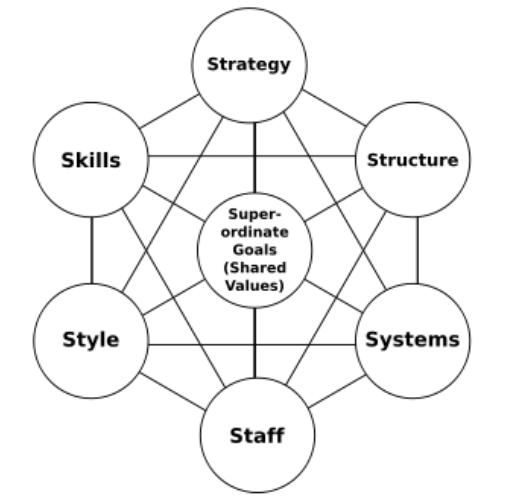
The 7 S –
a) Superordinate goals – are the fundamental ideas around which a business is built
b) Structure – salient features of the units’s organizational chart and inter connections within the office
c) Systems – procedures and routine processes, including how information moves around the unit
d) Staff – personnel categories within the unit and the use to which staff are put, skill base, etc
e) Style – characterization of how key managers behave in order to achieve the unit’s goals
f) Shared values strategy – the significant meanings or guiding concepts that the unit imbues on its members
g) Skills – distinctive capabilities of key personnel and the unit as a whole
The 7 S model can be used in two ways –
- Considering the links between each of the S’s one can identify strengths and weaknesses of an organization. No S is strength or a weakness in its own right, it is only its degree of support, or otherwise, for the other S’s which is relevant. Any S’s that harmonises with all the other S’s can be thought of as strength and weaknesses
- The model highlights how a change made in any one of the S’s will have an impact on all the others. Thus if a planned change is to be effective, then changes in one S must be accompanied by complementary changes in the others.


6 Comments